
Get in Touch
-
Phone
+92-323-2833936
-
Email Now
info@zyniti.com
-
Office # 454 ST 9, Sector 48/A Korangi 1/2 Karachi, Pakistan


Have you ever played a song on repeat, completely lost in its rhythm, but had no idea what the artist was actually trying to say? You are not alone. Millions of music lovers experience this every single day. That is exactly the gap Songtell was built to fill. In this in-depth Songtell review, we break down everything about this AI-powered song meaning platform, including who built it, how it works, what it costs, and whether it is worth your time in 2026.
Before anything else, let us address a question that surfaces frequently online: is Songtell owned by OpenAI? The answer is no. Songtell was independently created by Flavio Livolsi, a developer passionate about combining music and artificial intelligence. While the platform uses advanced natural language processing models that are similar in concept to large language models powering tools like ChatGPT, Songtell is not a product of OpenAI nor is it affiliated with the company.
Songtell is best described as a dedicated AI-powered lyric interpretation platform. It was one of the first tools of its kind to build an AI-generated song meanings repository at scale, and today it holds over 800,000 song interpretations in its database. Rather than just displaying raw lyrics like AZLyrics or Genius, Songtell digs into the emotional layers, metaphors, cultural references, and narrative arcs hidden inside the words of a song.
Using Songtell is refreshingly straightforward. You visit the website, type in the title of a song or the artist name, and within moments the platform surfaces an AI-generated interpretation of those lyrics. The analysis typically includes a thematic summary, emotional context, cultural and historical references, and a breakdown of specific metaphors the songwriter employed.
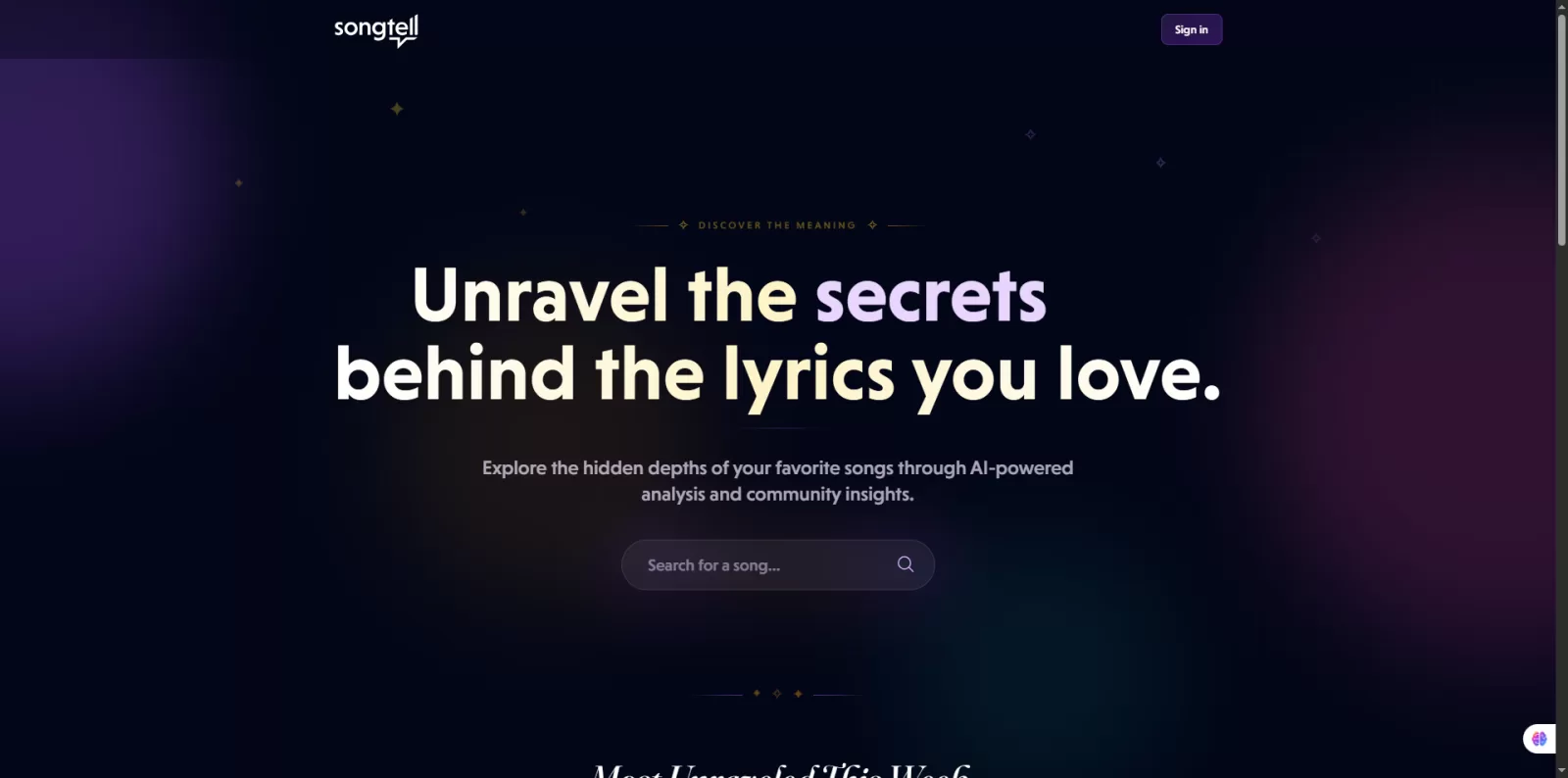
What makes Songtell more useful than a basic Google search is the structure of its output. Instead of one generic paragraph, you get layered insights: a quick summary up top, a detailed analysis below that, and sometimes source references to external lyric databases like Musixmatch to verify accuracy. This transparency in sourcing is a genuine differentiator from most competitors.
The AI behind Songtell combines semantic processing with a curated knowledge base of musical, cultural, and historical context. Interpretations also go through a human review layer for quality assurance, which helps improve the reliability of results for popular and well-known tracks.
With over 800,000 songs already analyzed and new interpretations added daily, Songtell has one of the largest AI-generated song meaning databases available anywhere. This makes it practical for everyday use, especially for mainstream genres like pop, rock, hip-hop, R&B, indie, and even folk and patriotic music. However, niche genres and very recent releases may still be missing from the catalog.
One standout feature that many reviewers overlook is that Songtell supports multiple languages. This makes it a genuinely global tool, accessible to non-English-speaking users who want to explore the meanings behind songs in their native language or understand English-language music more deeply.
This is one of the most creative and unique offerings on the platform. Songtell lets users order a physical or digital poster featuring the AI-generated meaning of their favorite song. It is a thoughtful gift idea for music lovers and a clever way for the platform to monetize without putting its core features behind a paywall.
Songtell has an active community on Reddit at r/songtell, where users share interpretations, discuss song meanings, and submit new requests. This community layer adds a human dimension to what would otherwise be a purely AI experience, and it helps surface song interpretations the database may not yet contain.
Users can upvote or downvote interpretations, which creates a crowdsourced quality signal. Songs with high approval scores rise to the top, helping new visitors quickly identify the most trusted and well-received analyses in the repository.
Songtell follows a freemium pricing model that is genuinely accessible. Browsing and reading existing song interpretations in the database is completely free with no account required. When you want to generate a new interpretation for a song that is not yet in the database, you will need credits.
New users receive free credits upon signing up, which means you can test the full experience without paying anything. Beyond that, credits are available at $0.99 for 10 song interpretations or $9.99 for 200 interpretations. For casual users, the free tier is more than sufficient. For music educators, content creators, or enthusiastic listeners who frequently need fresh analyses, the credit packs offer solid value.
Comparing Songtell to its nearest alternatives helps clarify exactly who it is built for.
Genius is the dominant player in lyric annotation, and its biggest strength is artist-verified content. Many annotations on Genius come directly from the musicians themselves, lending them an authority Songtell simply cannot match. However, Genius annotations are inconsistent in depth and coverage, especially outside of hip-hop and pop.
Spotify's Behind the Lyrics feature is convenient since it appears in the app as you listen, but it is brief and surface-level. It works well for casual curiosity but offers nothing close to the structured emotional and thematic analysis Songtell provides.
AZLyrics provides lyrics text only with zero interpretation. It has no analytical value for someone trying to understand a song on a deeper level.
Songtell sits in its own category: it is the tool for structured, AI-powered, multi-layered lyric interpretation at scale, with a free entry point and a growing multilingual database.
Songtell works particularly well for music lovers who want to connect with the emotional core of a song without spending hours researching it. It is also a genuinely valuable tool for educators who teach literature, poetry, or cultural studies, since songs are real-world examples of metaphor, narrative, and social commentary. Aspiring songwriters can use it to study thematic structures in successful music, and language learners find it helpful for understanding English idioms and expressions in context.
On the other hand, if you need artist-verified interpretations or are looking for very obscure, niche, or brand new releases, Songtell may leave you frustrated. The database, while large, is not exhaustive, and AI-generated interpretations are not endorsed by the artists.
Songtell is one of the most useful and underappreciated AI tools in the music space. Its combination of a massive song library, multilingual support, structured analysis, community engagement, and a free pricing model makes it a compelling choice for anyone serious about understanding music on a deeper level.
It is not perfect. The lack of artist verification means some interpretations are educated guesses rather than confirmed facts. But for casual listeners, students, educators, and music enthusiasts, Songtell delivers genuine value with minimal friction.
If you have never tried it, visit Songtell here and search for a song you have always wondered about. The experience is free, fast, and often surprisingly insightful.
Share your idea, business goal, or technical issue. We will review your message and reply with practical next steps.
Comments (0)
No comments yet,
Be the first to join the conversation.This discussion will show approved comments from readers.
Leave Your Comment: