
Get in Touch
-
Phone
+92-323-2833936
-
Email Now
info@zyniti.com
-
Office # 454 ST 9, Sector 48/A Korangi 1/2 Karachi, Pakistan


In a world where AI-generated text, deepfake videos, cloned voices, and synthetic images have become nearly indistinguishable from real content, the demand for reliable detection tools has never been higher. Whether you are an educator worried about AI-written assignments, a journalist verifying a suspicious video clip, or a business protecting its content integrity, you need a tool that goes beyond surface-level scanning. That is exactly where isFake.ai enters the picture.
This in-depth isFake.ai review covers everything you need to know before signing up, including how the tool actually works, what makes it different from competitors, who it is best suited for, where it falls short, and whether it is worth your money in 2026.
isFake.ai is a multi-modal AI content detection platform designed to identify whether text, images, audio, or video content was generated by an artificial intelligence system. Unlike tools that focus exclusively on written text, isFake.ai covers the full spectrum of digital content formats, making it one of the most versatile AI detection solutions currently available.
The platform uses advanced neural networks trained on millions of real and synthetic samples. It analyzes linguistic fingerprints in written content, diffusion noise and texture irregularities in images, temporal inconsistencies and lip-sync errors in video, and acoustic patterns in audio to produce a confidence score for each submission. That score tells you, in clear percentage terms, how likely it is that the content was AI-generated.
What sets isFake.ai apart from many competitors is that it does not just give you a verdict. It shows you why it flagged the content, using visual heatmaps for images, waveform analysis for audio, and highlighted sentence segments for text. This explanatory approach makes it significantly more useful for professionals who need to justify their conclusions to others, not just receive a pass or fail label.
The process of using isFake.ai is refreshingly simple. You start by selecting your content type, which can be text, image, audio, or video. From there, you either paste your text directly into the interface or upload a file, and the platform processes it in real time without requiring you to wait around.
Within seconds, you receive a detailed report. For written content, the report highlights specific phrases or passages that carry AI-like patterns such as overly smooth phrasing, unnatural repetition, or statistically predictable word choices. For images, a visual heatmap reveals which regions of the image contain synthetic artifacts or texture anomalies typical of tools like Midjourney, DALL-E, or Stable Diffusion. For audio, a waveform analysis flags regions of synthetic speech or cloned voice characteristics. For video, the tool scans for facial glitches, lighting mismatches, and frame-level inconsistencies common in deepfakes.
Notably, no account is required to begin testing the tool. You can start using it immediately, which makes the onboarding experience nearly frictionless.
Most AI detectors on the market handle only text. isFake.ai handles text, images, audio, and video from a single interface. This makes it highly practical for teams that deal with multiple content types, such as newsrooms, social media moderation teams, or marketing agencies vetting user-generated content.
The platform detects AI-written content from ChatGPT, Claude, Gemini, Llama, and other large language models. On the visual side, it identifies synthetic images from Midjourney, Stable Diffusion, and DALL-E. For video, it targets deepfakes including content generated with tools like Sora. For audio, it flags voice cloning and synthetic speech manipulation across common file formats including MP3, WAV, and AAC.
Rather than delivering a binary "real or fake" judgment, isFake.ai gives you a percentage-based confidence score alongside a breakdown of the specific signals that triggered detection. This is important because it keeps you in control. A 72% AI score on a piece of content tells you something very different than a 99% score, and understanding the underlying signals helps you make more informed decisions rather than blindly trusting an algorithm.
One concern many users have with AI detection tools is whether their submitted content gets stored or shared. isFake.ai is explicit that submitted content is processed in real time and not retained after analysis. Your data belongs to you, and you decide whether to share your results. This makes it a viable option even for sensitive professional environments.
For organizations that need to run large-scale content screening, the platform offers REST API access on its higher-tier plans. This allows developers to integrate detection capabilities directly into their own workflows, whether that is a content moderation pipeline, a publishing platform, or an internal editorial tool. The Team plan also includes webhooks, custom usage limits, a dedicated account manager, batch uploads, shareable reports, and audit logs.
isFake.ai operates on a freemium model. The free tier gives you basic daily checks across all content types, which is enough to evaluate the tool and get a feel for its accuracy on your specific use case.
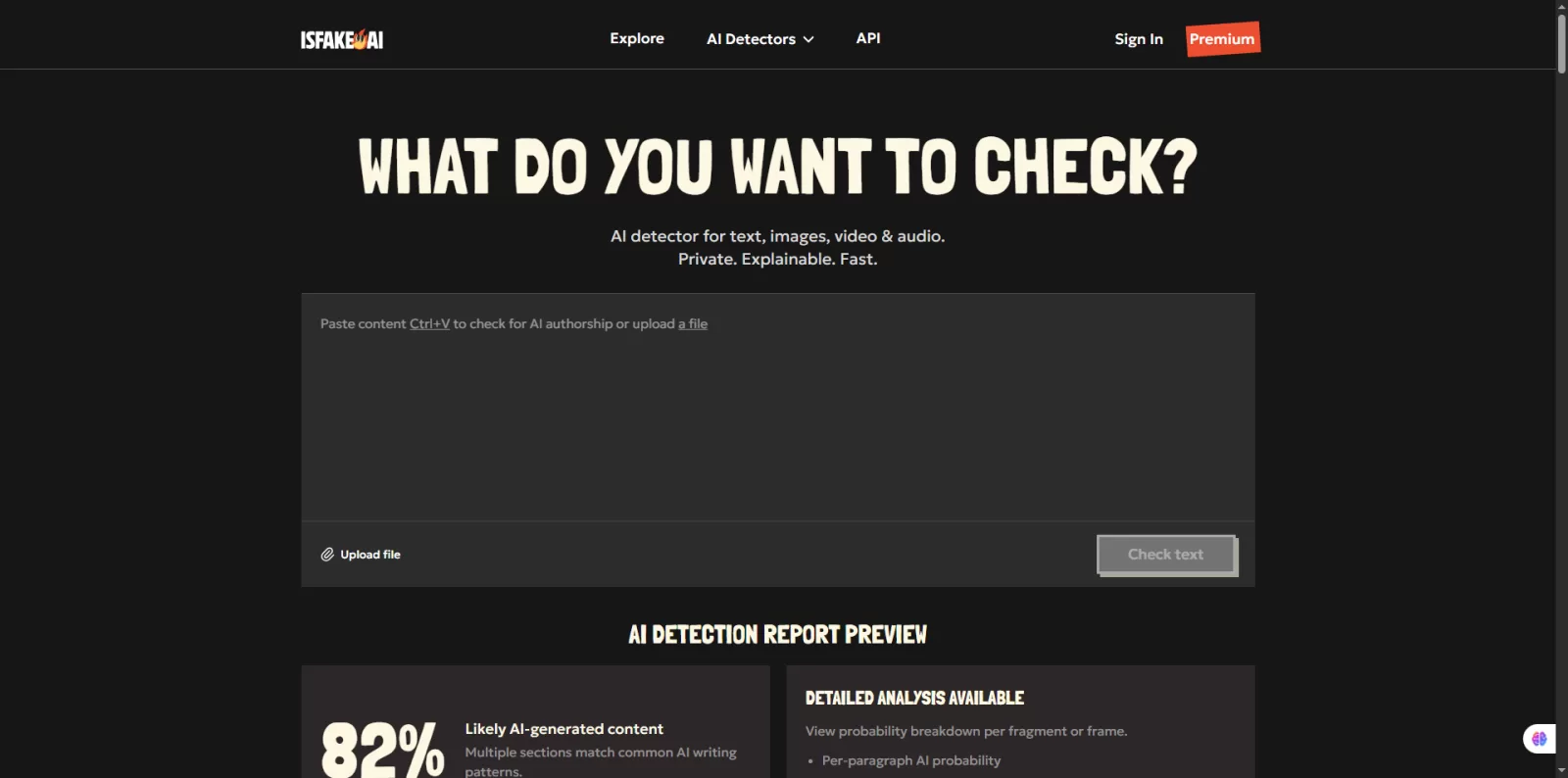
For users who need regular, higher-volume detection, there is a Premium subscription as well as a "Fix Pack" option for those who prefer to buy credits without committing to a monthly subscription. The Fix Pack suits occasional users or those who want to test a specific detector before subscribing. The Team plan is positioned for agencies, publishers, and enterprise teams that need API access, batch processing, and dedicated support.
A fair caveat on pricing: some users have noted that the credit system can feel confusing when running both AI detection and plagiarism checks simultaneously, as each analysis draws from your credit balance separately. It is worth reading the pricing details carefully on the official page before committing to a plan.
The tool is genuinely useful across a wide range of professional and personal use cases. Educators can use it to cross-check student submissions before making accusations, which reduces the risk of false positives that have unfairly penalized students who wrote their own work. The platform even includes a student transparency mode and classroom-safe reporting, which is a thoughtful addition that many competing tools skip entirely.
Journalists and fact-checkers can verify suspicious images, videos, or audio clips before publishing or sharing them. Content moderators at platforms dealing with user-generated content can use the API to automate initial screening at scale. Marketers and SEO professionals can check whether content sourced from freelancers or agencies was AI-generated. Legal and compliance teams can use it for an initial triage on media evidence before commissioning deeper forensic analysis.
No AI detection tool is perfect, and isFake.ai is no exception. Detection accuracy can dip noticeably when content is short, heavily edited, or deliberately crafted to evade detection. If a piece of AI-generated text has been substantially rewritten by a human, the confidence score will likely be lower, reflecting genuine ambiguity rather than a system failure.
The tool is also web-based only, meaning it requires an internet connection and currently lacks a dedicated mobile app or offline functionality. For teams working in secure environments or with strict data governance requirements, this may be a barrier worth evaluating before committing.
False positives remain a real concern across the industry, not just for isFake.ai. Human-written content that is unusually formal, highly structured, or written in a non-native language can sometimes trigger AI detection flags. The platform acknowledges this openly and encourages users to treat detection results as one input in a broader evaluation process, not as a final verdict.
Compared to text-only detectors like GPTZero or Originality.ai, isFake.ai has a clear advantage in scope. Its multi-modal coverage means you are not paying for separate tools to handle different content types. Compared to specialized deepfake detectors focused on social media streams, isFake.ai offers more detailed reporting and a broader format range, though real-time browser-based scanning for live video is not currently part of its offering.
Where isFake.ai genuinely differentiates itself is in the combination of multi-format support, explainable results, a privacy-first approach, and a credit-based pricing model that accommodates both casual users and enterprise teams without forcing everyone into a subscription.
After reviewing isFake.ai thoroughly, it earns a strong recommendation for professionals and organizations who need reliable, multi-format AI content detection without managing multiple separate tools. Its explanatory confidence scores, visual heatmaps, and waveform analysis give it a depth that many competitors lack. The free tier makes it easy to test before committing, and the tiered pricing structure is flexible enough to suit individuals, small teams, and larger enterprises.
That said, treat it as a powerful first-pass tool rather than an infallible judge. Pair it with human judgment, especially for consequential decisions in education, journalism, or legal contexts. If content authenticity matters to your work, isFake.ai is a serious tool that deserves a place in your verification workflow.
Share your idea, business goal, or technical issue. We will review your message and reply with practical next steps.
Comments (0)
No comments yet,
Be the first to join the conversation.This discussion will show approved comments from readers.
Leave Your Comment: